Posted on Leave a comment

Happy 10th Birthday EBiSC!

We are very proud to mark 10 years of the European Bank for induced pluripotent Stem Cells distributing high-quality human induced pluripotent stem cell (iPSC) lines.

Initially established in 2014 with support from the Innovative Health Initiative and EFPIA, EBiSC distributed its first iPSC lines in 2016 and since then has shared iPSC lines to researchers all over the world.

With a catalogue of >1000 iPSC lines, covering >45 diseases as well as isogenic, familial and age-sex matched controls, EBiSC has become a trusted resource for researchers internationally, enabling access to well-characterised, quality-controlled iPSCs that underpin advances across a wealth of topics including tissue and disease modelling, organoids, genomics and feeding into drug discovery and regenerative medicine.

We’d like to share a huge thank you to our project partners, collaborators, depositors and Users whose continued engagement has been instrumental in shaping EBiSC’s success. Special thanks to Culture Collections for their previous role as the EBiSC distribution hub. We also recognise the dedication of our teams in Fraunhofer UK Research Ltd and Fraunhofer Institute for Biomedical Engineering who are responsible for operating EBiSC and whose expertise and commitment ensure the highest standards in cell banking, data management, and distribution. Thank you all!

As we look to the future, EBiSC remains committed to expanding access, enhancing quality, and supporting innovation in stem cell research. If you’d like to work with us, get in touch via Contact@EBiSC.org.

Posted on Leave a comment

2025 at EBiSC: new iPSCs, new partners, continued excellence.

As we finish our second year operating independently and sustainably, we want to take a moment to reflect on the progress we have made in 2025 and to thank our teams, partners and collaborators who have contributed to making it a success. It has been a year of hard work, collaboration and teamwork, fed by our continued commitment to building a sustainable, long-term resource for the scientific community.

Expanding the EBiSC collection with new disease relevant iPSC lines

This year, we were pleased to welcome a number of new iPSC lines into the EBiSC collection, strengthening the diversity of iPSCs we can provide for disease-modelling and translational research. Newly added lines include models for Alzheimer’s disease, Angelman syndrome, and congenital muscular dystrophy (CMD) — each representing an important and fast moving area of iPSC research.

These additions broaden the scope of iPS cells and data which we are able to make available to researchers worldwide and reflect our commitment to continuing to provide a secure, sustainable and long-term home for iPSC lines generated across diverse research projects.

Improved access through new international distribution partnerships

To improve how we share resources to researchers worldwide, EBiSC has established new delivery partnerships to support regional and international shipping across Australia, New Zealand, Japan and the USA. These local partners help reduce delivery times, streamline logistics and lower shipping costs, ensuring that EBiSC iPSCs reach laboratories more efficiently than ever.

We look forward to strengthening these relationships in 2025 and improving access for new and existing users across additional regions.

A strong year for banking, quality control and data management

Behind every iPSC line in the EBiSC catalogue, a huge amount of work is invested into cell banking, quality control, documentation and data management. This is possible thanks to the strong partnership between Fraunhofer UK and Fraunhofer IBMT, who jointly operate and maintain the EBiSC collection. The shared commitment from our teams in the UK and Germany to quality assured cell banking and QC, robust and secure cryostorage and FAIR data principles ingrained into our IT infrastructure, ensure the longevity, sustainability and reliability of the EBiSC resource for years to come. A huge thank you to all involved!

Looking Ahead

As we prepare for the new year, we remain dedicated to expanding the collection, enabling access to high-quality datasets and supporting the global iPSC research community through collaboration, cell and service provision and development of new resources, tools and models.

From all of us at EBiSC, thank you for your continued engagement and support throughout 2025.

We wish you a restful winter break and a bright start to 2026.

Merry Christmas and Happy New Year!

Posted on Leave a comment

New iPSC Resource Available for Alzheimer’s Research via EBiSC!

A new study just published in Stem Cell Reports (PMID 40614728) introduces the IPMAR Resource funded by the UK Dementia Research Institute (UKDRI): a collection of human induced pluripotent stem cell (iPSC) lines designed to reflect high and low polygenic risk for Alzheimer’s disease. This comprehensive panel captures extremes of genetic predisposition across early- and late-onset forms of AD, with over a high number of donor-derived lines representing diverse clinical and genetic profiles pubmed.ncbi.nlm.nih.gov+6ukdri.ac.uk+6ebisc.org+6.

Key highlights:

  • Models span high- and low-risk individuals based on global and complement‑pathway AD polygenic risk scores
  • All lines come with linked clinical, longitudinal, and genetic data

🎉 The great news? The iPSC lines are now available through EBiSC, offering a vital tool for disease modelling and further research.

➡️ Learn more and secure access via the EBiSC catalogue. https://ebisc.org/collections/ipmar_alzheimers_disease

📩 For inquiries or collaboration opportunities, feel free to get in touch.

Posted on Leave a comment

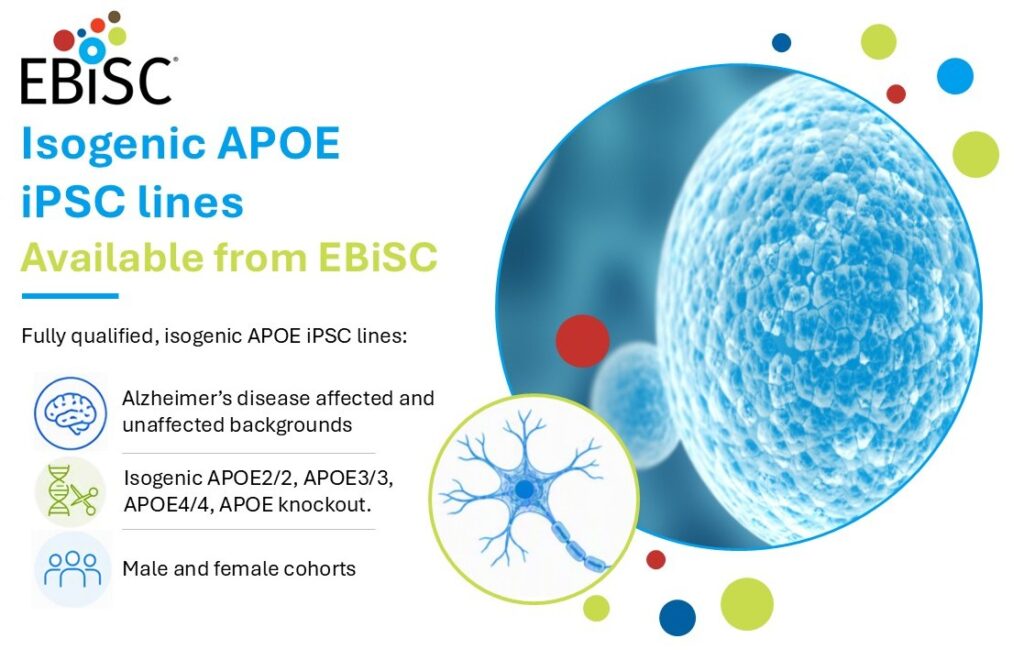
New publication: “Generation of a set of isogenic, gene-edited iPSC lines homozygous for all main APOE variants and an APOE knock-out line”

A new EBiSC related manuscript led by the EBiSC partner Bioneer and entitled “Generation of a set of isogenic, gene-edited iPSC lines homozygous for all main APOE variants and an APOE knock-out line” has been published in Stem Cell Research